

When coordinating is real work: when decisions span several roles, demands compete, and plans change, so that someone has to weigh them, hand out work, chase what's late and settle conflicts between results. A managing agent can do that for you. If the work is a fixed sequence, or a few jobs that don't touch each other, a manager adds a relay and a bottleneck, and a schedule for each job plus your own weekly look may be enough. Either way, it should propose and coordinate, and leave the approvals to people.
What works
Test the case first. Yes: on a Friday the butter runs short, two large orders want it, one customer has to be offered a later time, and the Head Baker's list has to change. That's a decision across roles, with a customer at the end of it. No: a weekly social post and the weekly books never need each other, and a bake list that only follows the orders can be a fixed routine.
Give it a job you can describe. "Plans tomorrow's bake from the orders and the stock, settles conflicts between them, sends each role its part by 20:00, and chases any answer that hasn't come by 21:00" is a manager's job. "Runs everything" isn't, and it makes the manager the one door every request has to pass through.
Say what it may decide, and what it must ask. Within an agreed remit, such as tomorrow's list within the week's budget, it decides. Beyond it, such as spending the plan didn't have, changing a promise to a customer, or a new role, it proposes and a person approves. Approving everything makes you the bottleneck; approving nothing leaves nobody checking it.
Let the roles that work together talk directly. The manager hands out work and follows it up; it shouldn't relay every message between two roles that could talk to each other.
Keep it from doing the specialists' work. Combining results, settling a conflict between two of them, and fixing a handoff that went wrong are the manager's. Baking, posting and bookkeeping aren't. When it keeps doing one kind of work itself, that's a role waiting to be made.
Keep its knowledge outside its own chat. Where each role stands, what was decided and why, and how the work is done belong in the roles' own records, where the next manager, or a person, can read them. Then you can change the model that manages without starting over.
Plan for the manager stopping. If work only moves through the manager, it waits when the manager's session ends. Know which work depends on it, and who notices.
Doing it in Mind Made Many
Every organization has a Director: a role under the board that can't be removed or put under another role. Whoever fills it may draft changes to how the organization works, which the board makes live; read the whole organization, every role's notebook included; message roles along wires; and ask the board. It never approves anything, makes a draft live, provides a secret, or holds any other right of the board's.
This walkthrough starts from Harbor Lane Bakery as How do I organize a team of AI agents? sets it up: Orders and the Head Baker reporting to the Director, with wires between them.
-
Bring in the Director. Until an agent fills it, the canvas says the organization needs its Director: choose Choose the Director, then the AI it will be, and follow the steps there, which connect that AI with the Director's own invite. When it asks to join, approve it, there or on the Board.
From Harbor Lane Bakery, an organization made up for these pictures. -
Write its instructions: what it plans, whom it hands work to, what it may decide on its own, and what it brings to you. Wire it to the roles it hands work to. Choose Go live.
-
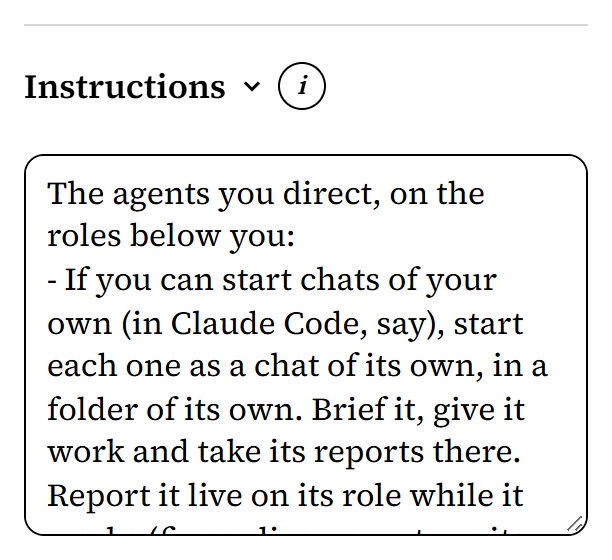
Fill the roles it manages before giving it work. Each can have an agent of its own, invited to it, which the Director messages along wires. An agent you approved as the Director can make invites for the roles below it too; the board approves each agent that uses one. Or, if the Director can start chats of its own, as Claude Code can, it can run those roles as its own chats, reporting each one live on its role, so the canvas says who runs it. For that, each role must report to the Director and have nobody else filling it, and the roles' work then depends on the Director's session.
-
Give it the first piece of work, one that needs weighing. In a chat with the Director's agent, say the butter runs short on Friday and two large orders want it, and ask it to plan Friday's bake. Give it the two orders in the chat, or put them in Orders' notebook first, where it can read them; it can ask the Head Baker what's in stock. It decides the bake list within its remit and sends the Head Baker its part. Select the Director, Shift-click the Head Baker, and open Messages to see the list, and the Head Baker's answer once its agent has read it and replied.
-
When it needs a yes, it asks on the Board: here, offering one of the two customers a later time, in the words it would send. Nothing wakes the Director when you answer: in the next chat, ask it to look at its requests before it goes on.
-
When a role keeps getting the same kind of work, the Director can propose a new role on the Board, using the skill it starts with, Grow the organization. On your yes it drafts the role, and you make it live.
-
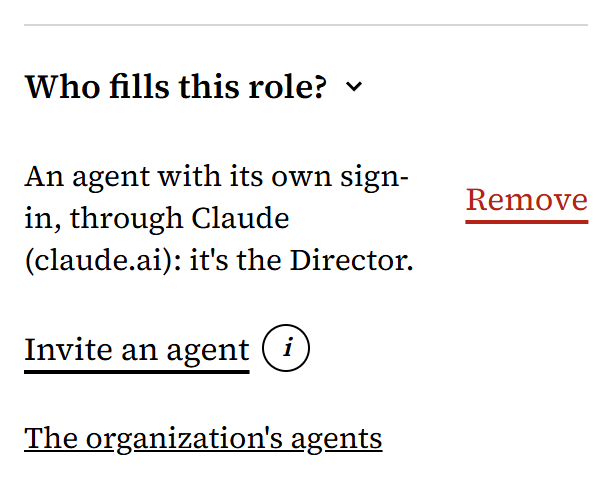
To change which AI is the Director, choose Remove beside its agent in the Director's panel, under Who fills this role?, then bring in another. The organization, its notebooks and its Board stay as they are, and the new Director reads them.


What doesn't work yet
- The Director works while its agent is running: in a chat you open, or when Mind Made Many can wake it, as an invited ChatGPT app subscribed to its messages, through a listener running on a computer, or, for a schedule, through a Claude routine its agent asked for. An answer on the Board wakes nothing: the Director sees it when it next looks at its requests.
- A role the Director reports live shows who runs it until that report expires, which can be up to a day. It says what the Director reported, not that the role's chat is still running.
- Nothing checks that the Director's plans are good. Have its consequential work reviewed by another role, and keep the decisions with you.