

When the work shows you a seam, and a trial shows that splitting along it helps. The seams are: one kind of request that keeps coming back and has grown its own procedures and decisions, instructions that have become two jobs pulling in different directions, and other work that keeps waiting behind it. Every split adds a handoff, and every handoff is a place where work can be dropped, done twice or misunderstood, so the split has to buy more than it costs.
What works
Stay with one agent while you can. When the work is small, when its steps follow one another and need the same context (one document, one customer, one conversation), or when it changes too fast to divide, one agent with good notes is usually simpler than a team.
Split on evidence. Look at what actually reaches the role: the requests, the messages, the notes it keeps. When the same kind of work keeps coming and has grown procedures and decisions of its own, it's a candidate.
Try it before you settle on it. Run the split for a while and compare it with how things were: what got finished, what went wrong, what waited, and how much time went on handing things over. If nothing improved, fold it back.
Keep tightly coupled steps together. "Wedding cakes", owned from the first email to the delivery, makes a good role. "Write the quote" and "send the quote" as two roles put a handoff in the middle of every order. The exceptions are a check by someone other than the author, and a step that needs authority the others shouldn't have, such as paying.
Watch for the other signs. Two sets of rules in one set of instructions that contradict each other. Parts of the job that need different tools, different access or a different pace: one answers customers within minutes, the other reconciles accounts on Fridays.
Tell a lasting specialist from temporary help. A large one-off job, split among several agents for a week, needs a way to divide and recombine the work, not new permanent roles.
Keep a general role. The original role keeps everything that isn't the specialist's, and takes the new kinds of work nobody owns yet.
Move the knowledge with the work, and move it back. The procedures and decisions for that area go to the specialist, and back again if the specialist is folded in.
At a bakery, Orders handles special orders, and wedding cakes take over: tastings, deposits, delivery to a venue on a Saturday, each with its own notes. A Wedding cakes role beside Orders takes that area. Orders keeps birthday cakes and everything else, and passes wedding requests on. After a month the owner compares the two, on similar requests: if weddings are answered faster, nothing was dropped between the roles, and the handovers cost less time than they save, the split stays. If not, or if wedding requests dry up, the specialist is folded back into Orders.
Doing it in Mind Made Many
A role's panel has Split this role, which makes a specialist beside it, under the same manager, with a copy of the role's instructions plus the area it takes on, its skills, the wires it sends on, and any wire its manager has to it. Nobody fills the new role yet, and it waits in the draft until you go live. The Director starts with a skill, Grow the organization, for proposing a split to the board when it sees this pattern, and folding one back when its area goes quiet.
-
Look at the evidence: the role's notebook shows its recent jobs and requests and its message activity, and its pages show what it has learned.
-
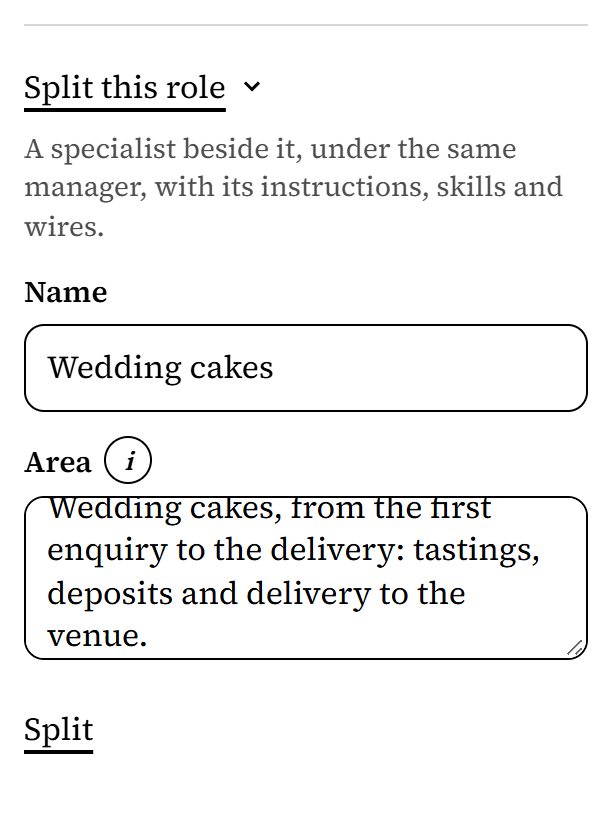
Select Orders and open Split this role. Name the specialist, Wedding cakes, write the area it takes on ("Wedding cakes, from the first enquiry to the delivery: tastings, deposits and delivery to the venue"), and choose Split.
From Harbor Lane Bakery, an organization made up for these pictures. -
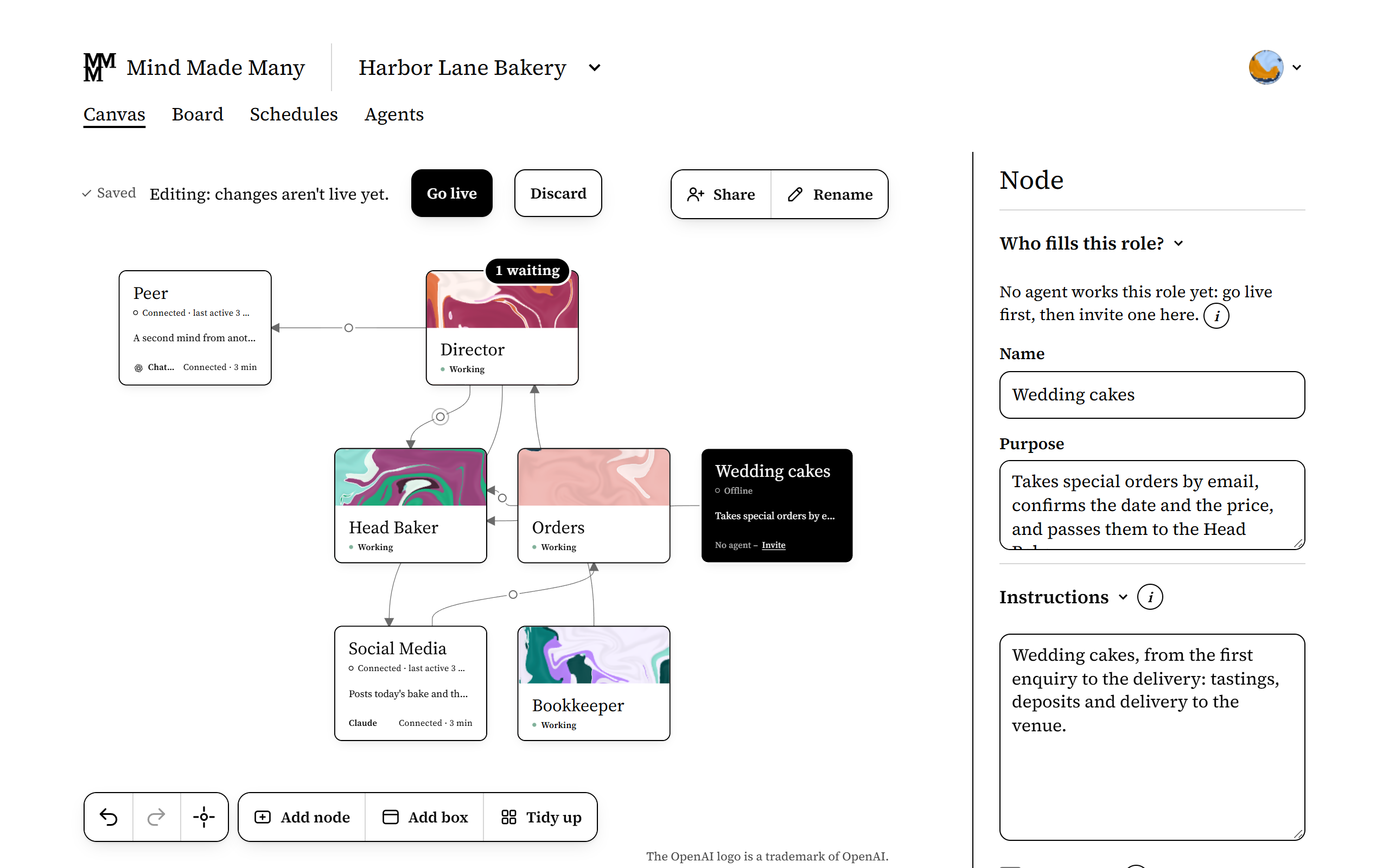
Narrow both roles in the draft. Edit Orders' instructions so wedding requests go to Wedding cakes, and Wedding cakes' purpose and instructions so it keeps only its area. Remove any wire Wedding cakes doesn't need, wire Orders to Wedding cakes so Orders can pass wedding requests on, and wire anyone else who should reach it. A schedule can't be moved from one role to another: give Wedding cakes its own, with the same what, time and notebook page, and remove Orders' (the removed one's past runs go with it).
-
Prepare its knowledge before it takes any work. First have Orders' agent finish or pause its wedding work, and hold new wedding requests until the handover is done. Then move the area's pages from Orders' notebook: open each one and move it to Wedding cakes' notebook, with its versions. A page whose title the other notebook already has must be renamed first. Start here can't be moved: write Wedding cakes' own, with the wedding orders under way and who has each. Notebook changes take effect at once, even if you discard the draft later.
-
Go live. Then fill Wedding cakes with an agent of its own: in its panel, under Who fills this role?, invite one, and approve it on the Board when it asks to join. A Director that can start chats of its own can run the role as one of them instead; the card then says Run by it. Check that both roles are filled.
-
Ask Orders' agent to pass a sample wedding request to Wedding cakes. Select the two roles and open Messages: check that the request arrived and that Wedding cakes' agent replied.
-
To fold it back, prepare Orders first: have Wedding cakes' agent finish or pause its work, move the pages back, update Orders' Start here with the wedding orders under way, and put the wedding work back in Orders' instructions. Ask the Director, or your own AI, to add any skill Orders now needs, and add the wires it needs. Then select Wedding cakes, choose Fold back into another role, choose Orders, choose Fold back, and go live. Its schedules move to Orders, anyone who reported to it reports to Orders, and its wires are removed with it.


What doesn't work yet
- A split copies the role's instructions, its skills, the wires it sends on, and any wire its manager has to it. You narrow both roles, and add every other wire the specialist needs, by hand.
- Notebook pages don't move by themselves, either way, and Start here never moves.
- A schedule doesn't move with a split: you make a new one and remove the old one.
- Folding back doesn't merge instructions, skills or notebook pages into the role it folds into. Its wires are removed, and the agent that filled it loses its role there once the change is live. To keep that agent, give it the role it folds into.