
Write down what the next session needs, put it where every session looks first, and make reading it the first thing the agent does. A chat's history is a poor memory: it's long, it mixes everything, and it belongs to one conversation. What a piece of work needs to carry from one session to the next is much smaller: where it stands, what's next, how the recurring things are done, the facts that matter, and what was decided and why.
What works
Keep the memory outside the chat, with the role that does the work. Then a fresh chat, a different model or a new agent in the role starts from the same place.
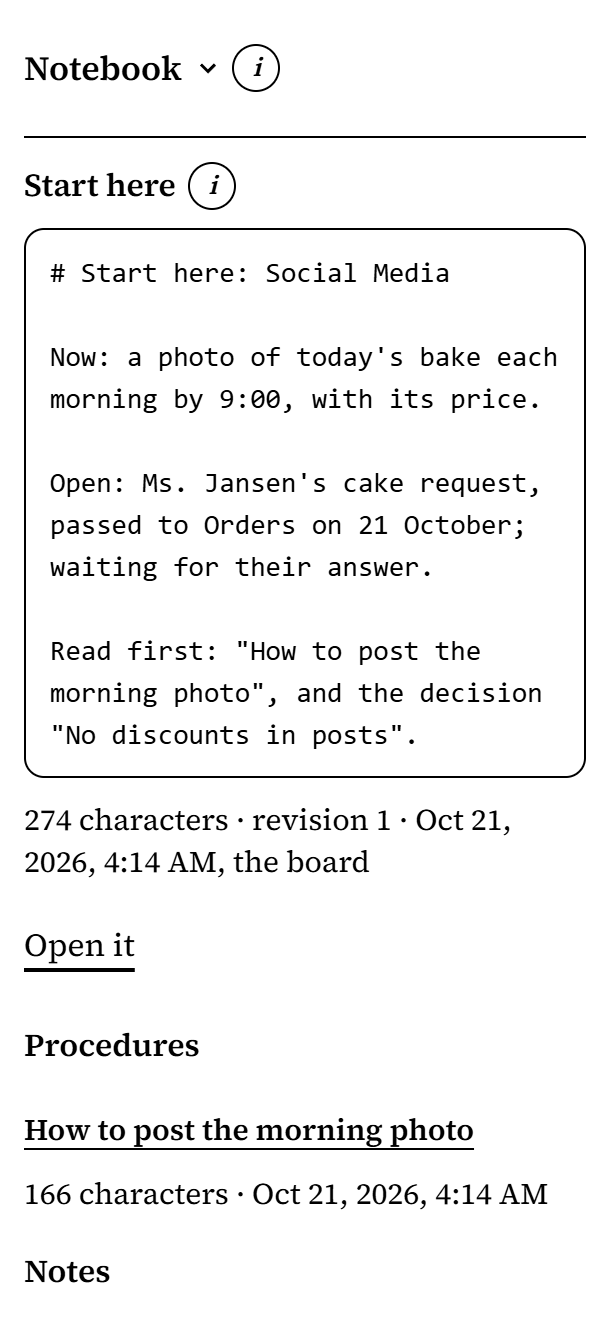
Keep a handover, and keep it short. One page the agent reads before anything else: what's going on now, what's open, what's next, and which other pages to read. Here's one for a bakery's social media role:
Today, 22 October: the morning photo (sourdough, 4.20 euros) posted at 8:41; link in the post log.
Open: cake request from Ms. Jansen, asked 21 October, for 12 people on Saturday. Passed to Orders; waiting for their answer. If there's none by Thursday noon, ask Orders again.
Next: Friday, post Saturday's market specials.
Read first: "How to post the morning photo", and the decision "No discounts in posts".
Give each open piece of work its own line, with a name you'd recognize, its state, and the next step. A role often has several things going at once, and a line per item keeps two of them from being confused, and lets one that's finished be crossed off.
Make it a routine, not a hope. The agent's standing instructions say to read the handover first. During the session, it writes things down as they happen, not at the end: a decision as soon as it's made, a fact as soon as it learns it. For an action that mustn't happen twice, it writes what it's about to do before starting, then the result and its evidence after ("posted at 8:41", with the link). Before it stops, it rewrites the handover: where things stand, and what's next. A session can stop at any point. An attempt with no result written down tells the next session to check what happened before trying again, and if it can't find out, to ask rather than repeat it.
Keep different kinds of things apart. A procedure is how the role does something, step by step. A note is a fact to remember. A decision is what was decided, by whom, when and why. Writing down the reason is what keeps a settled decision from being reopened by an agent that only finds the conclusion.
Replace a fact that changes; don't add a second one. When the flour supplier moves its order deadline, change the note, and say where the new deadline came from and when: "Flour orders by Thursday 12:00 (the supplier's email of 14 October)." Two notes that disagree leave the next agent guessing which one is true.
Keep the rules apart from the memory. What the role must always do belongs in its instructions, which people set. What it learned belongs in its memory, which it changes. When the two are mixed, a confused session can rewrite its own rules.
Keep secrets out. Every future agent in the role reads its memory, so a password written there goes wherever the memory goes. Name the secret, and keep its value somewhere made for it.
Test it. Open a fresh session, with another model if you can, and before it does anything, ask it to say where things stand, what's open, what it will do next, and what it's unsure of, from the handover and the pages it points to. Check its answer against what really happened. Where it's wrong or vague, look at what it actually read, whether that was still current, and whether the handover or the instructions for reading it need to change.
Doing it in Mind Made Many
Every role on the canvas has a notebook, and it belongs to the role, not to the agent in it: when you change who fills the role, the notebook stays, and the next agent starts from it. Its first page is Start here, the handover, and its other pages are procedures, notes and decisions. Mind Made Many's notebook tools tell an agent to read its role's notebook before it works, and to write in it as it learns. You read and write it from the role's panel, which also shows the role's recent jobs and requests, and its message activity.
-
Select the role on the canvas and open its Notebook.
-
Write its Start here: what the role is doing now, what's open, what's next, and which pages to read first.
From Harbor Lane Bakery, an organization made up for these pictures. -
Add pages as the role learns: procedures, notes, and decisions with who made them, when and why.
-
Put the routine in the role's instructions: read Start here first; write actions, decisions and facts as they happen; rewrite Start here before you stop. The tools ask the agent to read and write the notebook; the instructions add when. A change to the instructions is part of the canvas's draft, so choose Go live for it to apply.
-
When you change who fills the role, leave the notebook as it is. The next agent reads Start here, then the pages it points to.
-
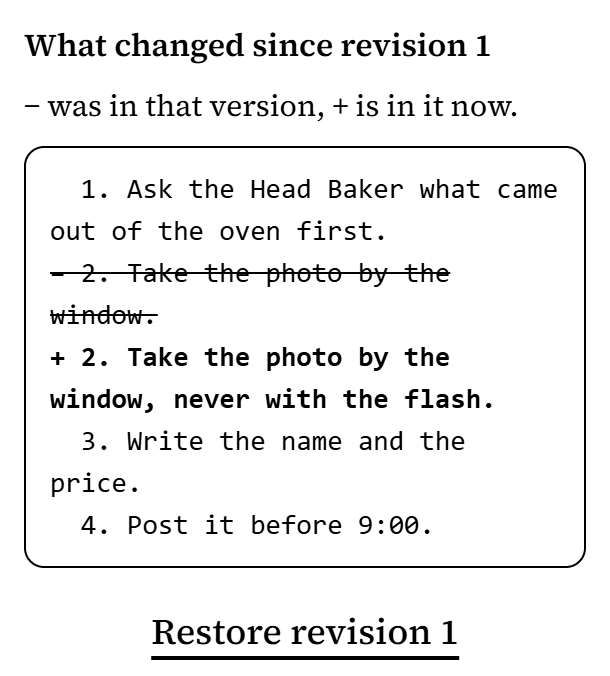
When a page's text looks wrong, open the page and look at its versions: each change to its text keeps the text it replaced, with who wrote it, and you can restore an earlier one.
What doesn't work yet
- A notebook holds only what someone wrote in it, and it helps only if the agent reads it. Nothing writes it for the agent, and nothing makes an agent read it beyond its instructions and its tools telling it to.
- A role has one Start here. When it has several pieces of work open, they share that page.
- A change to a notebook takes effect at once: it isn't part of the canvas's draft, and Discard doesn't undo it. A page's versions keep its earlier text, up to 30 of them, not its earlier titles.
- A notebook refuses text shaped like some well-known keys and tokens, such as an API key or a private key. It can't recognize a password, or every other kind of secret.
- A page holds up to 100,000 characters, and Start here up to 8 KB: keep it to what the next agent needs first.