
With a reviewer that doesn't simply see what the author saw, that works from the evidence rather than the author's conclusions, and that has to back each finding with something you can check. An agent reviewing its own work tends to approve it. Another agent can do better, but only if the review is set up so its agreement means something.
What works
Pick a reviewer that's unlike the author. A model from another lab was trained on different data in different ways, so it may not share the author's blind spots. That's a reason to use one. It isn't a reason to trust its verdict: two models can accept the same invented source without either of them opening it.
Make every finding carry its evidence. A finding is a failing case, a quoted source, a check that was run, or a requirement that isn't met, with where. "This looks wrong" is a prompt to look, not a finding. Agreement needs the same care: a review should say what passed, what failed, and what it couldn't check, for the version it read.
Review blind, in one of two ways. To get an independent answer, give the reviewer the question, the evidence and the requirements, and let it reach its own conclusion before it sees yours. To review something that already exists, such as a draft or a plan, give it the thing itself without the author's explanation of why it's right. Either way, ask for the case against before the verdict. Then show your own view, and ask where it breaks: the input, the edge case or the assumption that would make it wrong.
Review against what done looks like. "Is this good?" gets a polite answer. "Does it do these three things, and what shows it?" gets a useful one.
Sort what it finds. A blocker must be fixed before the work goes on; a fix should be made; a nit is taste. After a blocker is fixed, have the same reviewer check that the original failure is gone, and look at what else the fix touched. That's usually much less than reviewing everything again, and more than looking at the changed line alone.
Keep its disagreements, including the ones you overruled, in what goes to whoever decides.
Save reviews for what matters: a design, a decision that's hard to undo, work about to go to the people who approve it. When everything is reviewed, reviews turn into a formality.
Here's one at a bakery. The Director wants to move to a cheaper butter supplier on a twelve-month contract, which is hard to undo. It sends the reviewer the two suppliers' terms and what a good supplier has to meet, the same grade of butter and delivery before the morning bake starts at 5:00, without its recommendation. The reviewer quotes the cheaper supplier's delivery window from its terms, 9:00 to 12:00, which misses the bake. The Director asks the supplier for early delivery, and gets it in writing. The reviewer checks that written confirmation, and that the weekly costs still add up with the new delivery charge, and says what it couldn't check: whether the butter works as well in the bakery's recipes, which needs a trial bake. The proposal goes to the owner with all of that in it.
Doing it in Mind Made Many
A reviewer in Mind Made Many is a role like any other, wired in, rather than a built-in feature. A new account's first organization starts with one, the Peer: a role beside the Director under the board, meant for ChatGPT while the Director is meant for Claude, with a wire from the Director to it for "a blind read, a red-team and a review before anything consequential". The Director also starts with a skill, Ask the peer, in three steps: send the material with no conclusions and ask for the counter-case before the verdict; give your own view and ask the peer to break it; keep its disagreements in your report. Have your AI extend it with the rest: evidence for each finding, what wasn't checked, and the check after a fix.
-
Fill the reviewer. The Peer starts with no one filling it. Your own ChatGPT can fill it: connect it on Connections and choose it under Who fills this role?. Or invite an agent from a different lab than the roles it will review, and approve its request in the role's panel. You can also add a reviewer role of your own: make it live before you fill it.
-
Wire each role whose work should be reviewed to the reviewer. In the wire's Why, say when to ask and what to send: "Before any decision that's hard to undo: the material and what it must meet, without your conclusion." Have your AI give those roles the skill too. Then choose Go live: a wire carries messages only once it's live.
-
The role sends its material along the wire, and the reviewer answers with a reply, which comes back along the same wire. A message holds up to 4,000 characters, so long material goes as a summary, with the originals where the reviewer can read them: the role shares them with the reviewer as files, and the reviewer says if it can't open one. With your own ChatGPT filling the reviewer, the review happens when you open a ChatGPT chat and ask it to answer the reviewer's messages. An invited ChatGPT app can be woken when a message comes, once it has subscribed to its role's messages: ask it to check its Mind Made Many status, which says whether anything wakes it yet.
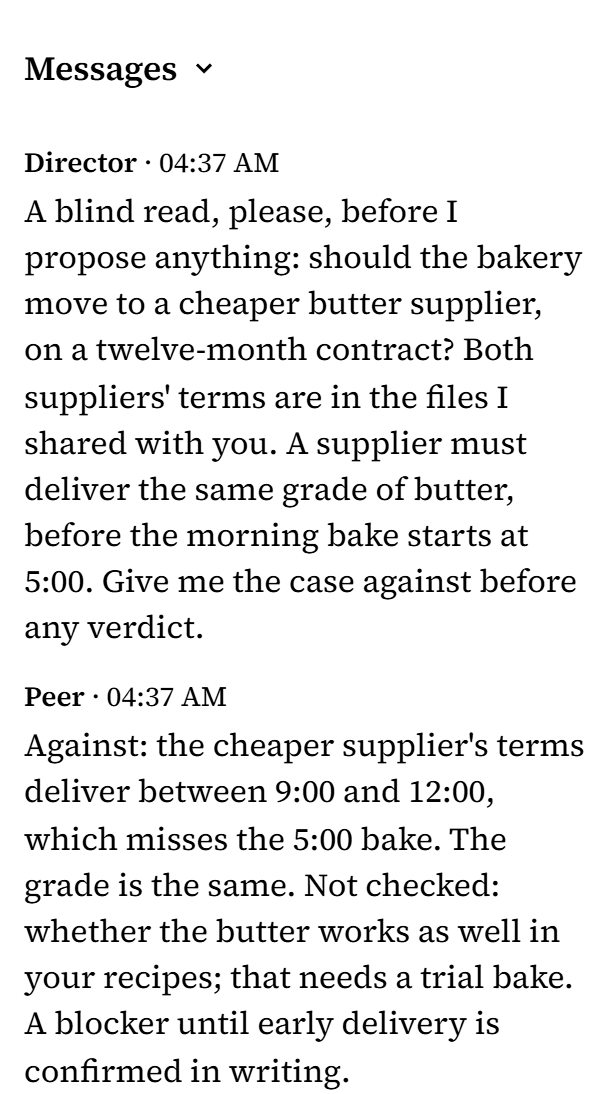
From Harbor Lane Bakery, an organization made up for these pictures. -
Have the reviewer keep its full review in its own notebook, which the Director can read. The role puts what decides the matter, and the ones it overruled, in what it sends you: a job's or a request's why holds up to 1,000 characters.
What doesn't work yet
- Nothing makes a role ask for a review. The wire and the skill make it easy and visible, and the role's instructions should say when it must.
- A reviewer's answer is advice. Nothing stops the work on its "no": you, or the role's instructions, decide what a blocker means.
- An invited reviewer reads only what its role may read. If you own the organization, your own ChatGPT, filling the role in every chat, can read the whole organization, as you can.